Buying Guide
4 Best Bivy Sacks Under 50 in 2026: A Practical Camping Guide
Best bivy sacks under $50, compared on weight, material and shelter type, from a 0.56 lb mesh bivy to a Tyvek cover and reusable emergency bags.

Fifty dollars is enough for a proper ultralight bivy, a reusable emergency bag or a Tyvek cover. Only four options fit the cap while staying genuinely useful, so the list is short and each pick has a distinct job.
The order reflects how well each one serves a camper who sleeps outdoors, with a mesh bivy shelter first and the bulk emergency pack last.
Danny’s Camping field notes
The Campsite Fit Check
A quick way to connect the shortlist to the space, workload and ownership details that matter after the box arrives.
- Start with the job
- HIKEBURGER Sleeping Bag Survival Bivy Sack leads this shortlist for Solo summer backpacking. Use that fit as a reference point, then compare the alternatives against your own space and workload.
- Specs that separate the picks
- The first details to compare are 0.56 lb mesh and nylon bivy, 5.1 oz, 400T nylon, DuPont Tyvek, 130g or 200g. Confirm the exact model and included components before ordering.
- Trade-off to plan for
- Tight inside with an inflatable pad
The Practical Shortlist
A practical look at 4 options, organized around the job each one suits best.

Best Value Under $50
HIKEBURGER Sleeping Bag Survival Bivy Sack
Solo summer backpacking
Our take Check price for HIKEBURGER Sleeping Bag Survival Bivy Sack (opens in a new tab)

Best Reusable Emergency Bag
Emergency Sleeping Bag Thermal Bivvy
Reusable emergency bag
Our take Check price for Emergency Sleeping Bag Thermal Bivvy (opens in a new tab)
Best Ultralight Cover
Sleeping Bag Liner
Ultralight bag protection
Our take Check price for Sleeping Bag Liner (opens in a new tab)

Best Bulk Pack
Qunclay 12 Pack Emergency Sleeping Bag
Groups and camps
Our take Check price for Qunclay 12 Pack Emergency Sleeping Bag (opens in a new tab)
| Pick | Best for | Key spec | Price |
|---|---|---|---|
| Solo summer backpacking | 0.56 lb mesh and nylon bivy | Check price for HIKEBURGER Sleeping Bag Survival Bivy Sack (opens in a new tab) |
| Reusable emergency bag | 5.1 oz, 400T nylon | Check price for Emergency Sleeping Bag Thermal Bivvy (opens in a new tab) |
| Ultralight bag protection | DuPont Tyvek, 130g or 200g | Check price for Sleeping Bag Liner (opens in a new tab) |
| Groups and camps | Twelve 82.7x35.4 in bags | Check price for Qunclay 12 Pack Emergency Sleeping Bag (opens in a new tab) |
Why You Can Trust Danny’s Camping
At Danny’s Camping, we compare products based on campsite fit, verified specifications, usability, setup requirements, weight, durability, and real-world trade-offs. We do not rank products purely on marketing claims or commission rates.
We have not personally tested every product listed. Where hands-on testing is not available, recommendations are based on verified manufacturer specifications, product documentation, use-case fit, and comparative research.
Why Each Pick Made the Cut
Best Value Under $50· 1 of 4
HIKEBURGER Sleeping Bag Survival Bivy Sack
Danny’s Take
A lightweight bivy tent that fits a tight pack and keeps bugs away.
Best for
- Solo summer backpacking
Why it made the shortlist
The HIKEBURGER is an ultralight one-person bivy sack made of mesh, 20D nylon and a 40D silicone nylon, weighing 0.56 pounds. It measures 78.74 by 23.62 by 19.68 inches and packs to about 7.9 by 3.9 by 3.3 inches.
It sits between an inner tent and a bivy bag, so it blocks mosquitoes and insects while staying under a tarp. Top of the price range in this group, it is also the single pick with a mesh living space.
It suits solo backpackers and thru-hikers who sleep under a tarp in buggy summer weather. It works best with a foam pad, since an inflatable pad can crowd the interior.
Key dimensions & specs
- 0.56 lb mesh and nylon bivy
- 78.74x23.62x19.68 inches
- Packs to about 8x4x3 inches
Pros
- Extremely light at 0.56 pounds
- Mesh blocks insects
- Packs very small
- Works under a tarp for rain
Cons
- Tight inside with an inflatable pad
- Needs a tarp for rain protection
The Catch
The interior is snug, so test it with your pad before a long trip.
Best Reusable Emergency Bag· 2 of 4
Emergency Sleeping Bag Thermal Bivvy
Danny’s Take
A smart pick for hikers who want a tougher emergency layer than plain foil.
Best for
- Reusable emergency bag
Why it made the shortlist
The Upneargo emergency bag weighs 5.1 ounces and is made of 400T nylon with a honeycomb heat-reflective material instead of plain film. The drawstring ends in a 120 decibel whistle, and a carabiner clips it to a pack.
Its nylon outer makes it tougher than the foil bags found at lower price points, so it can be reused.
It suits hikers who want a reusable emergency bag and a whistle in one item. It comes in three colors, so choose a bright one if rescue visibility matters.
Key dimensions & specs
- 5.1 oz, 400T nylon
- Honeycomb heat-reflective layer
- 120 dB whistle, carabiner
Pros
- Nylon outer holds up to reuse
- Whistle and carabiner included
- Very light at 5.1 ounces
- Three color options
Cons
- Emergency bag, not a full shelter
- No bug protection
The Catch
It does not replace a sleeping bag for a full night.
Best Ultralight Cover· 3 of 4
Sleeping Bag Liner
Danny’s Take
A very light cover for a bag you already own, and a good fit for tent campers.
Best for
- Ultralight bag protection
Why it made the shortlist
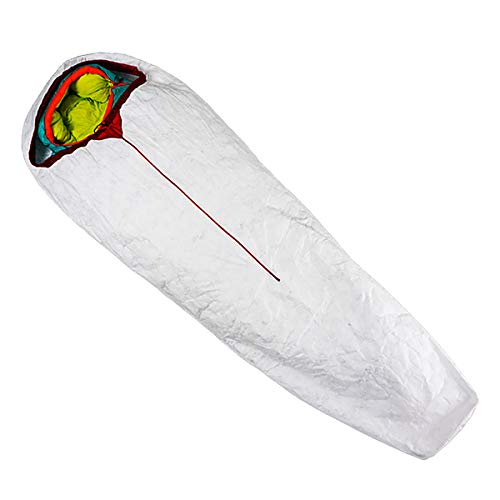
The 3F UL Gear cover is made of DuPont Tyvek and comes in two sizes: Type A at 180 by 80 centimeters and about 130 grams, and Type B at 230 by 90 centimeters and about 200 grams. It folds to about 16 by 8.5 centimeters.
It is the lightest pick by far and works as a breathable waterproof cover that keeps tent condensation off a sleeping bag.
It suits ultralight backpackers who want to protect a down bag from moisture. Use it inside a tent or under a tarp.
Key dimensions & specs
- DuPont Tyvek, 130g or 200g
- Type A 180x80 cm, Type B 230x90 cm
- Folds to 16x8.5 cm
Pros
- Ultralight at 130 grams
- Breathable Tyvek reduces condensation
- Folds very small
- Two size choices
Cons
- Must be used with a sleeping bag
- Does not add warmth
The Catch
Choose the larger Type B if you sleep in a wide bag.
Best Bulk Pack· 4 of 4
Qunclay 12 Pack Emergency Sleeping Bag
Danny’s Take
The right choice only if you need to equip a crowd.
Best for
- Groups and camps
Why it made the shortlist
The Qunclay set includes twelve emergency bivy sacks, twelve whistles and twelve nylon stuff sacks. Each bag measures about 82.7 by 35.4 inches and is made of aluminum foil film with a hood.
It is the cheapest per bag in this guide and fits groups, camps and school trips. The foil is thin, so these bags are for emergencies and not repeated use.
It suits scout troops, camp counselors and event organizers who need a bag for everyone. Store them in a dry bin.
Key dimensions & specs
- Twelve 82.7x35.4 in bags
- Whistle and stuff sack each
- Foil film with hood
Pros
- Twelve bags in one order
- Whistle with every bag
- Hood on each bag
Cons
- Too many bags for one person
- Thin foil
The Catch
A single camper will never use twelve bags.
How We Built This Shortlist
Each pick was assessed across 4 criteria weighted for real-world use.
- Shelter or cover
- Compared a mesh bivy shelter, a Tyvek cover and two emergency bag types by function.
- Weight
- Looked at stated weights, from 130 grams to about a half pound.
- Durability
- Compared nylon, Tyvek and foil film for how well each handles repeated use.
- Extras and count
- Counted whistles, carabiners, stuff sacks and number of bags in each order.
What Matters Before You Choose a Bivy Sack Under 50
Key buying criteria so you get the right fit the first time.
Bivy shelter type
Bivies come as mesh shelters, solid shells, covers and emergency bags, and each solves a different problem. A mesh bivy keeps bugs out, a shell sheds rain and a cover protects a sleeping bag from moisture. Look at the title and first features to see which type you are buying.
Fabric weight and denier
Denier measures thread thickness, so a 20D nylon is very light and a 40D floor is stronger. Lower numbers save weight but wear faster against rough ground. Look for denier on the floor, since that is where abrasion happens, and use a ground sheet under any floor under 40D. A stated denier is a more useful clue than the word ultralight, which has no fixed meaning.
Pad compatibility
Narrow bivies only fit a certain pad width, and an inflatable pad can bulge and press against the walls. A foam pad lies flat and leaves more room. Compare the bivy's width with your pad and bag before ordering, and check the stated interior height. A 19 inch height leaves little room for a fat inflatable pad or a puffy jacket worn inside the bag.
Condensation control
Tyvek and breathable fabrics let moisture escape, while non-breathable foil traps it. Cutting condensation matters in cool, humid weather. Look for words like breathable or ventilated in the title or specs. In practice, a mesh roof under a tarp or a Tyvek cover inside a tent manages moisture far better than a sealed foil bag, which can leave you damp by morning.
Pack size and weight
A 0.56 pound mesh bivy and a 130 gram Tyvek cover each save a lot of pack weight. If you carry gear by hand, weight matters less. Check the stated packed size against your pack, because a roll of about 8 by 4 by 3 inches fits in a side pocket while a foam-padded cover will not. Weigh the full setup, including a tarp and stakes, before you decide.
Match a Bivy Sack Under 50 to Your Camp Setup
By camping style
| Your situation | Recommended pick | Why |
|---|---|---|
| Solo backpacking in summer | HIKEBURGER Mesh Bivy | 0.56 pounds with insect mesh. |
| Hiker wanting a reusable emergency bag | Upneargo Reusable Bivy | Nylon outer and whistle. |
| Down bag in a tent | 3F UL Gear Tyvek Cover | 130 gram breathable cover. |
| Scout troop or event | Qunclay 12-Pack | Twelve bags with whistles. |
Scroll sideways to see every column.
By Budget
| Budget | Recommended pick |
|---|---|
| $30 to $40 | Upneargo Reusable Bivy or Qunclay 12-Pack |
| $40 to $50 | HIKEBURGER Mesh Bivy or 3F UL Gear Tyvek Cover |
Bivy shelter vs bag cover
- Shelter
- A mesh bivy like the HIKEBURGER Mesh Bivy is its own small shelter, which keeps bugs off you. It needs a tarp for rain.
- Cover
- A cover like the 3F UL Gear Tyvek Cover wraps a sleeping bag and adds moisture protection. It does not add warmth or bug protection.
Most campers should buy the HIKEBURGER Mesh Bivy for summer trips and add the 3F UL Gear Tyvek Cover for tent camping.
By budget
| Pick | Recommended pick |
|---|---|
| Around $40 for a group | Qunclay 12-Pack |
| Around $40 for one | Upneargo Reusable Bivy |
| Around $47 | HIKEBURGER Mesh Bivy |
| Around $50 | 3F UL Gear Tyvek Cover |
For ultralight camping specifically
- Look for
- Look for a stated weight under 1 pound and a small packed size.
- In this comparison
- The HIKEBURGER Mesh Bivy weighs 0.56 pounds and the 3F UL Gear Tyvek Cover weighs 130 or 200 grams.
When to Spend More
- Spend more if
- Spend more if you want both bug protection and a shelter, which means the HIKEBURGER Mesh Bivy. If you want a larger shelter, a one-person tent tier above $75 is worth a look.
- Save if
- Save if you only need an emergency layer, because the Upneargo Reusable Bivy gives a sturdy bag for about $40.
Before You Bring One Home
Is a bivy sack better than a tent?
A bivy is lighter and takes less room, but gives little space to sit or change clothes. A tent costs more and weighs more, though it handles long rain better. The HIKEBURGER Mesh Bivy is a good compromise for summer trips.
Can I use a Tyvek cover alone?
No. The 3F UL Gear cover is meant to be used with a sleeping bag, and it is best inside a tent or under a tarp. It stops condensation from reaching the bag and adds no warmth.
What size Tyvek cover do I need?
Type A is 180 by 80 centimeters and fits a narrow mummy bag, while Type B is 230 by 90 centimeters and suits taller or wider campers. Measure your bag length and add 10 centimeters. The 3F UL Gear Tyvek Cover comes in both sizes.
Do I need a tarp with a mesh bivy?
Yes, if rain is possible. A mesh bivy has a waterproof floor, though the mesh roof does not shed rain. Pitch a tarp above the HIKEBURGER Mesh Bivy and stake the edges to keep the floor dry.
How do I use an emergency bag correctly?
Wear dry layers, get on insulation such as a pad or leaves, and close the hood around your face while leaving a small gap for air. The Upneargo Reusable Bivy has a drawstring for that. Do not seal it fully, since you will build condensation.
Bottom Line
Best overall: HIKEBURGER Sleeping Bag Survival Bivy Sack — best value under $50 pick in this roundup. See the full verdicts above for every pick, with pros, cons and who each one suits.
Browse all bivy sacks under 50 on Amazon — Prime-eligible options with current pricing.
Related Guides
About the author
Danny Walker
Founder & Lead Editor at Danny’s Camping
Danny covers camping gear, campsite setup, outdoor power, sleep systems, and practical camping advice, with a focus on helping campers make better gear decisions.