
Buying Guide
6 Best Camping Inverters in 2026: A Practical Camping Guide
Best camping inverters compared on continuous watts, outlet count, USB ports and power source, for car campers who need AC power at the site.


A camping inverter turns 12V battery power into household AC, so the numbers that matter are continuous watts, outlet count and what feeds it. A cigarette-socket plug-in and a battery-clamp unit behave very differently once the load goes past a laptop.
Six inverters made this list, from a 2000W pure sine wave unit down to a 200W socket adapter and a power-tool-battery model. They were compared on listed continuous and peak watts, outlets, USB output and the safety protections each listing names.
Danny’s Camping field notes
The Campsite Fit Check
A quick way to connect the shortlist to the space, workload and ownership details that matter after the box arrives.
- Start with the job
- BELTTT 2000W Pure Sine Wave Inverter 12V DC to 120V AC leads this shortlist for Battery-bank camp power. Use that fit as a reference point, then compare the alternatives against your own space and workload.
- Specs that separate the picks
- The first details to compare are 2000W continuous, 4000W surge, 400W continuous, 800W peak, 300W continuous, 40A fuse. Confirm the exact model and included components before ordering.
- Trade-off to plan for
- Needs thick cables and a real battery bank
The Practical Shortlist
A practical look at 6 options, organized around the job each one suits best.

Best Overall
BELTTT 2000W Pure Sine Wave Inverter 12V DC to 120V AC
Battery-bank camp power
Our take Check price for BELTTT 2000W Pure Sine Wave Inverter 12V DC to 120V AC (opens in a new tab)
Best Plug-In Power
Pro Chaser 400W Power Inverters for Vehicles DC 12v to AC 110v Car Inverter
Laptop and camera charging
Our take Check price for Pro Chaser 400W Power Inverters for Vehicles DC 12v to AC 110v Car Inverter (opens in a new tab)
Best for Two Outlets
BESTEK Power Inverter DC 12-17V to AC 110V
Everyday device charging
Our take Check price for BESTEK Power Inverter DC 12-17V to AC 110V (opens in a new tab)

Best Compact Pick
300W Portable Charger Car Power Inverters for Vehicle
Passenger-seat charging
Our take Check price for 300W Portable Charger Car Power Inverters for Vehicle (opens in a new tab)

Best Budget
PiSFAU 200W Car Power Inverter
Light-duty road trips
Our take Check price for PiSFAU 200W Car Power Inverter (opens in a new tab)
Best Cordless Option
220W Azocek Power Inverter Compatible with Milwaukee 18V Battery
Tool-battery owners
Our take Check price for 220W Azocek Power Inverter Compatible with Milwaukee 18V Battery (opens in a new tab)
Why You Can Trust Danny’s Camping
At Danny’s Camping, we compare products based on campsite fit, verified specifications, usability, setup requirements, weight, durability, and real-world trade-offs. We do not rank products purely on marketing claims or commission rates.
We have not personally tested every product listed. Where hands-on testing is not available, recommendations are based on verified manufacturer specifications, product documentation, use-case fit, and comparative research.
Why Each Pick Made the Cut
Best Overall· 1 of 6
BELTTT 2000W Pure Sine Wave Inverter 12V DC to 120V AC
Danny’s Take
The only true battery-bank inverter here, with enough watts for a fridge and a few small appliances.
Best for
- Battery-bank camp power
Why it made the shortlist
The BELTTT is a 2000W pure sine wave inverter with 4000W of peak surge, two AC sockets, a 20A outlet and a hardwire port. It adds a 5V 2.1A USB port, a bright LCD and a remote with 23 ft of cable.
Against the Pro Chaser 400W it offers five times the continuous output and a clean sine wave for inductive loads.
It suits campers running a battery bank for a fridge, lights and a small appliance. The remote lets the unit sit near the battery while the switch stays inside the camper.
Key dimensions & specs
- 2000W continuous, 4000W surge
- Pure sine wave output
- LCD plus 23 ft remote
Pros
- Pure sine wave suits sensitive electronics
- Hardwire port plus two sockets
- Remote control on a long cable
- Undervoltage, overload and reverse protections
Cons
- Needs thick cables and a real battery bank
- Priciest pick in this list
The Catch
Heavy loads at 12V pull very high current, so cable gauge, fuse size and battery capacity all matter.
Best Plug-In Power· 2 of 6
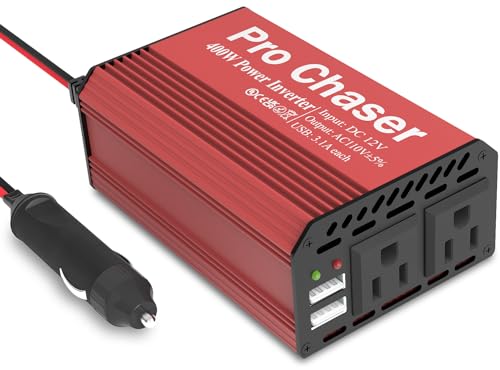
Pro Chaser 400W Power Inverters for Vehicles DC 12v to AC 110v Car Inverter
Danny’s Take
A plug-in inverter with more headroom than the 300W units, sized for laptops and camera gear.
Best for
- Laptop and camera charging
Why it made the shortlist
The Pro Chaser gives 400W continuous and 800W peak through two 110V sockets plus 3.1A USB ports. It is phone-sized with a 30 inch cord and a fan that starts at 113 degrees F.
It sits between the BELTTT and the 300W adapters. It has more headroom than the BESTEK and YSOLX and keeps the same plug-in convenience, while the BELTTT needs a battery connection.
It fits car campers who charge laptops, camera batteries and similar devices from the vehicle. Keeping it on one device at a time suits the vehicle socket limits.
Key dimensions & specs
- 400W continuous, 800W peak
- Dual AC plus dual USB
- 30 inch cord
Pros
- Plug-in use with no wiring
- Two AC sockets and fast USB ports
- Fan activates at a set temperature
- Small enough for a glove box
Cons
- Vehicle socket fuse limits real output
- No pure sine wave claim
The Catch
A cigarette socket usually supports far less than 400W, so keep the load small or use direct battery clamps.
Best for Two Outlets· 3 of 6
BESTEK Power Inverter DC 12-17V to AC 110V
Danny’s Take
A sturdy 300W plug-in with a named fuse and a long cord for charging laptops and tablets.
Best for
- Everyday device charging
Why it made the shortlist
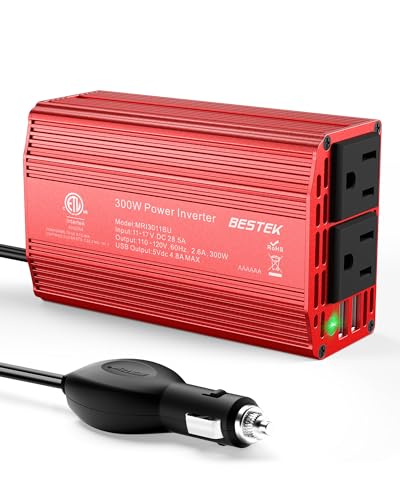
The BESTEK provides 300W continuous with two 110V sockets and two 4.8A USB ports. Its listing names an 11 to 17V input range, a 40 amp fuse, an aluminum housing and a 32 inch plug cord.
Compared with the Pro Chaser it has less peak capacity and a lower price. Against the YSOLX it adds a named fuse rating and a rugged aluminum shell.
It suits campers who want a dependable laptop and tablet charger with a longer cord. The wide voltage range also covers vehicles with higher charging voltages.
Key dimensions & specs
- 300W continuous, 40A fuse
- Two AC plus two 4.8A USB
- 11 to 17V input
Pros
- Aluminum housing resists bumps
- Named 40 amp fuse
- Longer 32 inch cord
- Quiet cooling fan
Cons
- 300W limits it to small electronics
- Plug-in cord can stretch to the seat
The Catch
Appliances with heating elements are beyond a 300W unit, so keep it to electronics.
Best Compact Pick· 4 of 6
300W Portable Charger Car Power Inverters for Vehicle
Danny’s Take
The lightest 300W pick, with enough USB ports to charge a whole carload of phones.
Best for
- Passenger-seat charging
Why it made the shortlist
It measures 5.4 by 2.75 by 1.4 inches and weighs 9.17 oz.
Next to the BESTEK it gives up the metal case and the fuse rating, yet it provides more USB ports. Against the PiSFAU it adds 100 more watts for a similar footprint.
It works for backseat charging when several phones and a laptop are plugged in at once.
Key dimensions & specs
- 300W, four 24W USB ports
- Double 110V AC outlet
- 9.17 oz, pocket size
Pros
- Four USB ports for a full car
- Lightweight and compact
- Smart cooling fan runs quietly
Cons
- Not for heaters or hair dryers
The Catch
The listing warns against hair dryers and heaters, so it stays strictly an electronics charger.
Best Budget· 5 of 6
PiSFAU 200W Car Power Inverter
Danny’s Take
A budget socket adapter for phones, tablets and a small laptop on short trips.
Best for
- Light-duty road trips
Why it made the shortlist
The PiSFAU is a 200W car inverter with two US AC outlets and four USB ports in an ABS shell. It measures 2.7 by 1.4 by 5 inches and weighs about 8.5 oz.
It has the lowest output here, 100W under the 300W pair, and it is also the cheapest.
It suits first-time buyers who want a basic cigarette-socket adapter for road trips. A fully insulated case adds a layer of electrical safety.
Key dimensions & specs
- 200W, two AC outlets
- Four USB ports
- Fully insulated ABS shell
Pros
- Four USB ports plus two AC
- Insulated ABS shell
- Protects against overheating and overload
Cons
- Only 200W of output
- Plastic body is less rugged
The Catch
At 200W it handles light electronics only, so a camp coffee maker is out of reach.
Best Cordless Option· 6 of 6
220W Azocek Power Inverter Compatible with Milwaukee 18V Battery
Danny’s Take
A cordless way to charge phones and a laptop if you already own Milwaukee 18V batteries.
Best for
- Tool-battery owners
Why it made the shortlist
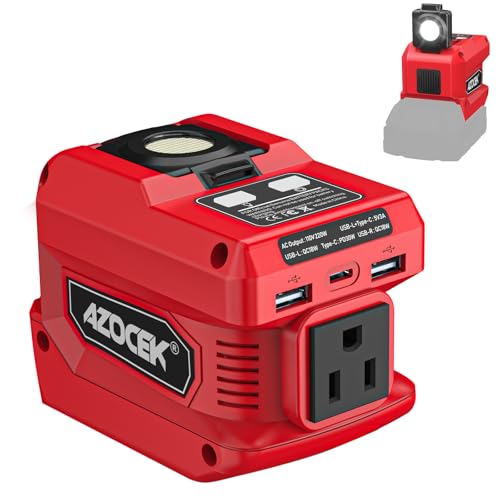
The Azocek runs from Milwaukee 18V batteries and delivers 220W through one AC outlet, two 18W USB QC ports and a 30W PD Type-C port. It adds a 400 lumen LED work light with a strobe mode.
It is the one pick that needs no vehicle at all, which separates it from the plug-in units. Compared with the PiSFAU it offers similar output with the battery you already own.
It suits campers who already carry Milwaukee 18V tool batteries. The light doubles as emergency lighting at the picnic table.
Key dimensions & specs
- 220W from Milwaukee 18V
- 30W PD plus two 18W USB
- 400LM LED work light
Pros
- Works with batteries you may own
- Built-in 400 lumen work light
- Fast USB-C PD port
- Short circuit and over-discharge protection
Cons
- Battery packs are sold separately
- Compatible only with Milwaukee 18V packs
The Catch
The listing is for the inverter body only, so budget for packs and check the model numbers it names.
How We Built This Shortlist
Each pick was assessed across 5 criteria weighted for real-world use.
- Continuous watts
- Listed continuous output was compared across 200W, 300W, 400W and 2000W units.
- Power source
- Plug-in socket, battery-clamp and tool-battery designs were separated first.
- Ports
- AC outlets and USB-C versus USB-A counts were compared.
- Protection
- Named fuses, shut-off protections and housing materials were noted.
- Portability
- Weight, size and cord length were weighed for camp use.
What Matters Before You Choose a Camping Inverter
Key buying criteria so you get the right fit the first time.
Continuous versus surge watts
Continuous watts is what the inverter can supply all day, while surge or peak watts is a short burst for a motor starting. A fridge or pump may need two or three times its running watts at startup. Add up the running watts of everything you plan to use at once and pick an inverter whose continuous rating covers it with room to spare.
Vehicle socket limits
A 12V cigarette socket is usually fused around 10 to 15 amps, which is roughly 120 to 180 watts of real power. A plug-in listed at 300W or 400W cannot deliver that through the socket, so treat the big number as a ceiling rather than a promise. Check the listing for a socket warning, and for anything over about 150W use battery clamps or a direct connection.
Pure sine wave output
Pure sine wave inverters produce power close to what a wall outlet gives, which suits motors, CPAP machines and sensitive chargers. Modified sine wave units are cheaper and fine for simple chargers, yet some electronics run hot or buzz on them. The listing should name pure sine wave outright; if it does not, assume modified.
Battery drain and wiring
An inverter pulls a lot of current from a 12V battery, and 1000W works out to roughly 85 amps. Run it without the engine on and a starter battery can be flat in under an hour, while a deep-cycle battery needs the right cable gauge and a fuse near the terminal. Look for included cables and a stated low-voltage shutoff.
Outlets and protections
Count the AC sockets and USB-C ports against the devices you will actually plug in. Look for overload, short circuit, over-temperature and reverse polarity protection named on the listing. A named fuse rating or a certification mark is a better sign than a generic safety badge.
Match a Camping Inverter to Your Camp Setup
By Camp Setup
| Your situation | Recommended pick | Why |
|---|---|---|
| Battery bank for a fridge and lights | BELTTT 2000W Inverter | The only direct-connect unit with 2000W continuous. |
| Laptop and camera in the car | Pro Chaser 400W Inverter | The most headroom among the plug-ins. |
| Laptop and tablet with fuse detail | BESTEK 300W Inverter | Names a 40 amp fuse and a metal shell. |
| A carload of phones | YSOLX 300W Inverter | Four 24W USB ports in a pocket-size case. |
| Phone and tablet only | PiSFAU 200W Inverter | Cheapest for light loads. |
Scroll sideways to see every column.
By Budget
| Budget | Recommended pick |
|---|---|
| $10 to $30 | PiSFAU 200W Inverter or YSOLX 300W Inverter |
| $20 to $30 | BESTEK 300W Inverter or Azocek 220W Tool-Battery Inverter |
| $30 to $160 | Pro Chaser 400W Inverter or BELTTT 2000W Inverter |
Plug-in vs Battery Connection
- Plug-in
- A cigarette-socket inverter needs no wiring but is limited by the vehicle socket fuse. The Pro Chaser 400W Inverter, BESTEK 300W Inverter, YSOLX 300W Inverter and PiSFAU 200W Inverter all work this way.
- Battery connection
- A direct-connect inverter draws from the battery with heavy cables and can run far bigger loads. The BELTTT 2000W Inverter is the one pick built for this.
Most car campers should stay with a plug-in like the BESTEK 300W Inverter unless a fridge or heater-class load is planned.
By Power Source
| Source | Recommended pick |
|---|---|
| Vehicle cigarette socket | Pro Chaser 400W Inverter |
| Deep-cycle or lithium battery | BELTTT 2000W Inverter |
| Milwaukee 18V tool battery | Azocek 220W Tool-Battery Inverter |
| Cheapest socket adapter | PiSFAU 200W Inverter |
Car Camping Without Hookups
- Look for
- A pure sine wave inverter or a plug-in with named protections, plus a realistic watt total for the gear you carry.
- In this comparison
- The BELTTT 2000W Inverter covers a battery bank for the fridge and lights, while the Pro Chaser 400W Inverter handles laptop charging from the car.
When to Spend More
- Spend more if
- Spend more on the BELTTT 2000W Inverter if you run a fridge or small appliances off a battery bank, because only it is built for those loads.
- Save if
- Save with the PiSFAU 200W Inverter or YSOLX 300W Inverter if the plan is phones, tablets and a laptop on the road.
Before You Bring One Home
Can an inverter run a camping fridge?
Yes, if the running watts and startup surge fit under the inverter's ratings and the battery is big enough. A compressor fridge needs a surge allowance, so the BELTTT 2000W Inverter is the realistic pick here. A 200W or 300W plug-in cannot carry that startup.
What is the biggest mistake with plug-in inverters?
Believing the 400W label applies through the cigarette socket. Most vehicle sockets are fused far lower, which is why listings like the YSOLX recommend loads under 150W. Stay under that number or wire the inverter to the battery.
Is a pure sine wave inverter worth it?
For sensitive electronics, motors and medical devices, yes. For phone and laptop chargers, a plug-in like the BESTEK 300W Inverter is usually enough. Pay for sine wave when a load is picky about its power.
How do I connect a battery-clamp or hardwired inverter safely?
Use the shortest, thickest cables the listing includes, add a fuse near the battery positive terminal, and keep the inverter ventilated and dry. Connect the inverter off, then switch it on. Never run it in a closed space with a flooded battery that can vent gas.
Can I leave an inverter running overnight?
Only if the battery can afford it. Even idle inverters draw current, and a low-voltage shutoff will cut power if the battery sags. Switch it off when not in use, and keep a charger or solar input handy.
Bottom Line
Best overall: BELTTT 2000W Pure Sine Wave Inverter 12V DC to 120V AC — best overall pick in this roundup. See the full verdicts above for every pick, with pros, cons and who each one suits.
Browse all camping inverters on Amazon — Prime-eligible options with current pricing.
Related Guides

About the author
Danny Walker
Founder & Lead Editor at Danny’s Camping
Danny covers camping gear, campsite setup, outdoor power, sleep systems, and practical camping advice, with a focus on helping campers make better gear decisions.