
Buying Guide
3 Best 12v Car Power Inverters in 2026: A Practical Camping Guide
Best 12V car power inverters compared on current draw, plug-in versus battery-cable design and safety notes, for drivers who want AC outlets in the vehicle.


Every car inverter works from 12 volts, so the useful math is amps: divide the wattage by 12 and you see why a 3000W model cannot live on a cigarette socket. That single calculation separates the plug-in units from the cable-connected ones.
Three inverters represent the range, from a 300W plug-in to a 3000W unit that connects to the battery. They were compared on listed continuous and peak watts, outlets and ports, sine wave type and the cautions each listing prints.
Danny’s Camping field notes
The Campsite Fit Check
A quick way to connect the shortlist to the space, workload and ownership details that matter after the box arrives.
- Start with the job
- Power Inverter 3000 Watt leads this shortlist for Vehicles with a battery bank. Use that fit as a reference point, then compare the alternatives against your own space and workload.
- Specs that separate the picks
- The first details to compare are 3000W continuous, 6000W peak, 400W continuous, 800W peak, 300W continuous, 40A fuse. Confirm the exact model and included components before ordering.
- Trade-off to plan for
- Needs heavy cables and a strong battery
The Practical Shortlist
A practical look at 3 options, organized around the job each one suits best.

Most Power
Power Inverter 3000 Watt
Vehicles with a battery bank
Our take Check price for Power Inverter 3000 Watt (opens in a new tab)

Best Plug-In Power
Pro Chaser 400W Power Inverters for Vehicles DC 12v to AC 110v Car Inverter
Laptop and camera charging
Our take Check price for Pro Chaser 400W Power Inverters for Vehicles DC 12v to AC 110v Car Inverter (opens in a new tab)
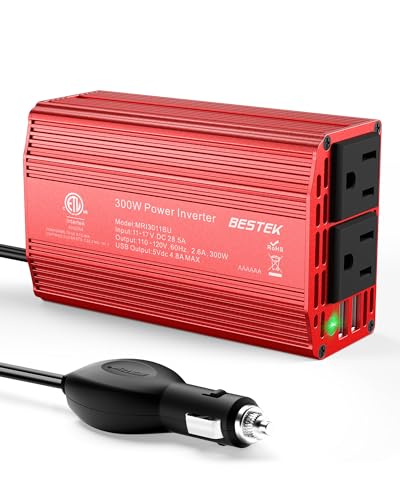
Best Value Plug-In
BESTEK Power Inverter DC 12-17V to AC 110V
Everyday device charging
Our take Check price for BESTEK Power Inverter DC 12-17V to AC 110V (opens in a new tab)
| Pick | Best for | Key spec | Price |
|---|---|---|---|
| Vehicles with a battery bank | 3000W continuous, 6000W peak | Check price for Power Inverter 3000 Watt (opens in a new tab) |
| Laptop and camera charging | 400W continuous, 800W peak | Check price for Pro Chaser 400W Power Inverters for Vehicles DC 12v to AC 110v Car Inverter (opens in a new tab) |
| Everyday device charging | 300W continuous, 40A fuse | Check price for BESTEK Power Inverter DC 12-17V to AC 110V (opens in a new tab) |
Why You Can Trust Danny’s Camping
At Danny’s Camping, we compare products based on campsite fit, verified specifications, usability, setup requirements, weight, durability, and real-world trade-offs. We do not rank products purely on marketing claims or commission rates.
We have not personally tested every product listed. Where hands-on testing is not available, recommendations are based on verified manufacturer specifications, product documentation, use-case fit, and comparative research.
Why Each Pick Made the Cut
Most Power· 1 of 3
Power Inverter 3000 Watt
Danny’s Take
A cable-connected inverter with the headroom for appliances and tools.
Best for
- Vehicles with a battery bank
Why it made the shortlist
The TOPBULL delivers 3000W continuous and 6000W peak from a 12V battery connection. The listing names a modified sine wave output, an oversized color LED screen, an aviation aluminum alloy housing and protections including over current, overload, over voltage, under voltage, high temperature, short circuit and reverse polarity.
It suits vehicles with a proper battery bank or an upgraded electrical system for tools and appliances. The listing adds a lifetime consultation service and product liability insurance.
Key dimensions & specs
- 3000W continuous, 6000W peak
- Modified sine wave output
- Color LED screen, aluminum case
Pros
- Highest wattage of the three
- Seven named protections
- Large color LED screen
- Rugged aluminum housing
Cons
- Needs heavy cables and a strong battery
- Modified sine wave only
The Catch
Full 3000W draws about 250 amps from a 12V system, so cables and fuse must match.
Best Plug-In Power· 2 of 3
Pro Chaser 400W Power Inverters for Vehicles DC 12v to AC 110v Car Inverter
Danny’s Take
A plug-in with more headroom than most, sized for laptops and camera gear.
Best for
- Laptop and camera charging
Why it made the shortlist
The Pro Chaser gives 400W continuous with 800W peak through two 110V AC sockets, two 3.1A USB ports and 4.8A dual USB charging. It comes with a 30 inch cord, a fan that starts at 113 degrees F and an overload, voltage and overheating protection set.
It is the more powerful of the two plug-ins, with 100W more continuous output than the BESTEK 300W. Compared with the TOPBULL it needs no wiring and fits a cup holder.
It suits drivers who charge a laptop or camera gear from the vehicle. The listing recommends a cool, dry environment and calls out handling cautions.
Key dimensions & specs
- 400W continuous, 800W peak
- 2 AC plus dual USB
- 30 inch cord, fan at 113F
Pros
- Plug-in design with no wiring
- Two AC sockets and fast USB
- Fan starts at a set temperature
- Phone-sized body
Cons
- Vehicle socket fuse limits real output
- No pure sine wave claim
The Catch
A 12V accessory socket usually supports far less than 400W, so keep the load modest.
Best Value Plug-In· 3 of 3
BESTEK Power Inverter DC 12-17V to AC 110V
Danny’s Take
A sturdy, low-cost plug-in with a named fuse and wide input range.
Best for
- Everyday device charging
Why it made the shortlist
The BESTEK provides 300W continuous with two 110V AC outlets and two 4.8A USB ports, a built-in 40 amp fuse and an aluminum housing. Input runs from 11 to 17V, and the cord that plugs into the socket is 32 inches long.
Against the TOPBULL it is a fraction of the power, which is what a 12V socket can usually supply.
It suits drivers who want a dependable device charger with a longer cord. Its input range also covers vehicles with higher charging voltages.
Key dimensions & specs
- 300W continuous, 40A fuse
- Two AC plus two 4.8A USB
- 11 to 17V input range
Pros
- Named 40 amp fuse
- Aluminum housing resists bumps
- 32 inch cord reaches the seat
Cons
- 300W suits electronics only
- Cord can tug on the socket
The Catch
Anything with a heating element is out of reach for a 300W unit.
How We Built This Shortlist
Each pick was assessed across 5 criteria weighted for real-world use.
- Wattage and amps
- Continuous and peak watts were converted to amps at 12 volts to judge each unit's draw.
- Connection
- Plug-in socket and battery-cable designs were separated.
- Outlets and USB
- AC sockets and USB ports were compared.
- Protections
- Named fuses and protection lists were noted.
- Cord and size
- Cord length, size and housing were compared.
What Matters Before You Choose a 12v Car Power Inverter
Key buying criteria so you get the right fit the first time.
Watts to amps at 12 volts
At 12 volts, current equals watts divided by 12, so 400W is about 33 amps and 3000W is about 250 amps. That is why bigger inverters need thick cables and heavy fuses. Do the math before you choose.
Accessory socket limit
A vehicle accessory socket is typically fused around 10 to 15 amps, which means roughly 120 to 180 watts of real power. Plug-in inverters labeled 300W or 400W cannot always deliver that through a socket. Check the listing for a load warning.
Engine on or off
Running an inverter with the engine off drains the starter battery, sometimes within an hour on heavier loads. Keep the engine running for bigger loads, or use a separate deep-cycle battery. Look for a low-voltage shutdown on the listing.
Sine wave type
Modified sine wave output is fine for simple chargers but may cause buzzing or heat in some electronics. The TOPBULL listing says modified. Check your device before connecting.
Cables, fusing and ventilation
A cable-connected inverter needs short, thick cables and a fuse near the battery. Give it ventilation and keep it dry. Look for named protections such as overload and reverse polarity.
Match a 12v Car Power Inverter to Your Camp Setup
By Connection
| Your situation | Recommended pick | Why |
|---|---|---|
| Appliance or tool loads from a battery | TOPBULL 3000W Inverter | 3000W continuous with 6000W peak. |
| Laptop and camera in the vehicle | Pro Chaser 400W Inverter | 400W with 800W peak. |
| Phone, tablet and laptop | BESTEK 300W Inverter | Named 40A fuse and aluminum housing. |
| Plug-in with a longer cord | BESTEK 300W Inverter | 32 inch plug cord. |
Scroll sideways to see every column.
By Budget
| Budget | Recommended pick |
|---|---|
| $20 to $30 | BESTEK 300W Inverter |
| $30 to $40 | Pro Chaser 400W Inverter |
| $160 to $170 | TOPBULL 3000W Inverter |
Plug-In vs Hardwired
- Plug-in
- Plug-in units need no wiring but are capped by the socket. The Pro Chaser 400W Inverter and BESTEK 300W Inverter work this way.
- Hardwired
- Cable-connected units draw from the battery and handle large loads. The TOPBULL 3000W Inverter is built for this.
Choose the BESTEK 300W Inverter for most vehicle charging and the TOPBULL 3000W Inverter for appliances.
By Budget
| Budget | Recommended pick |
|---|---|
| Lowest price | BESTEK 300W Inverter |
| Low price, more power | Pro Chaser 400W Inverter |
| Higher spend for 3000W | TOPBULL 3000W Inverter |
Daily Driving and Commuting Specifically
- Look for
- Continuous watts that match a laptop, plus a socket warning and a fuse rating.
- In this comparison
- The BESTEK 300W Inverter names a 40A fuse, and the Pro Chaser 400W Inverter adds headroom for a laptop plus charger.
When to Spend More
- Spend more if
- Spend more on the TOPBULL 3000W Inverter if the vehicle has a battery bank and you want appliance power.
- Save if
- Save with the BESTEK 300W Inverter if the plan is phones and laptops.
Before You Bring One Home
Will a 400W inverter really give 400W through a cigarette socket?
Usually not. A socket is typically limited to about 150W, so the label is a ceiling. The Pro Chaser 400W Inverter and BESTEK 300W Inverter both fit that rule.
What is the biggest mistake with 12V inverters?
Connecting a heavy load to a small unit. Heaters and hair dryers need far more power. Check the load in watts first.
Is a 3000W inverter worth it?
Only if you have the battery and cables for it. The TOPBULL 3000W Inverter draws about 250 amps at full load. Smaller plug-ins suit most drivers.
How do I connect a cable-based inverter?
Switch it off, attach thick cables to the battery with a fuse near the positive terminal, then power on. Keep it ventilated. Follow the TOPBULL 3000W Inverter manual.
Can an inverter drain my car battery?
Yes, if the engine is off. Even idle units draw current. Unplug it when not in use.
Bottom Line
Best overall: Power Inverter 3000 Watt — most power pick in this roundup. See the full verdicts above for every pick, with pros, cons and who each one suits.
Browse all 12v car power inverters on Amazon — Prime-eligible options with current pricing.
Related Guides

About the author
Danny Walker
Founder & Lead Editor at Danny’s Camping
Danny covers camping gear, campsite setup, outdoor power, sleep systems, and practical camping advice, with a focus on helping campers make better gear decisions.